Wednesday, 28 March 2012

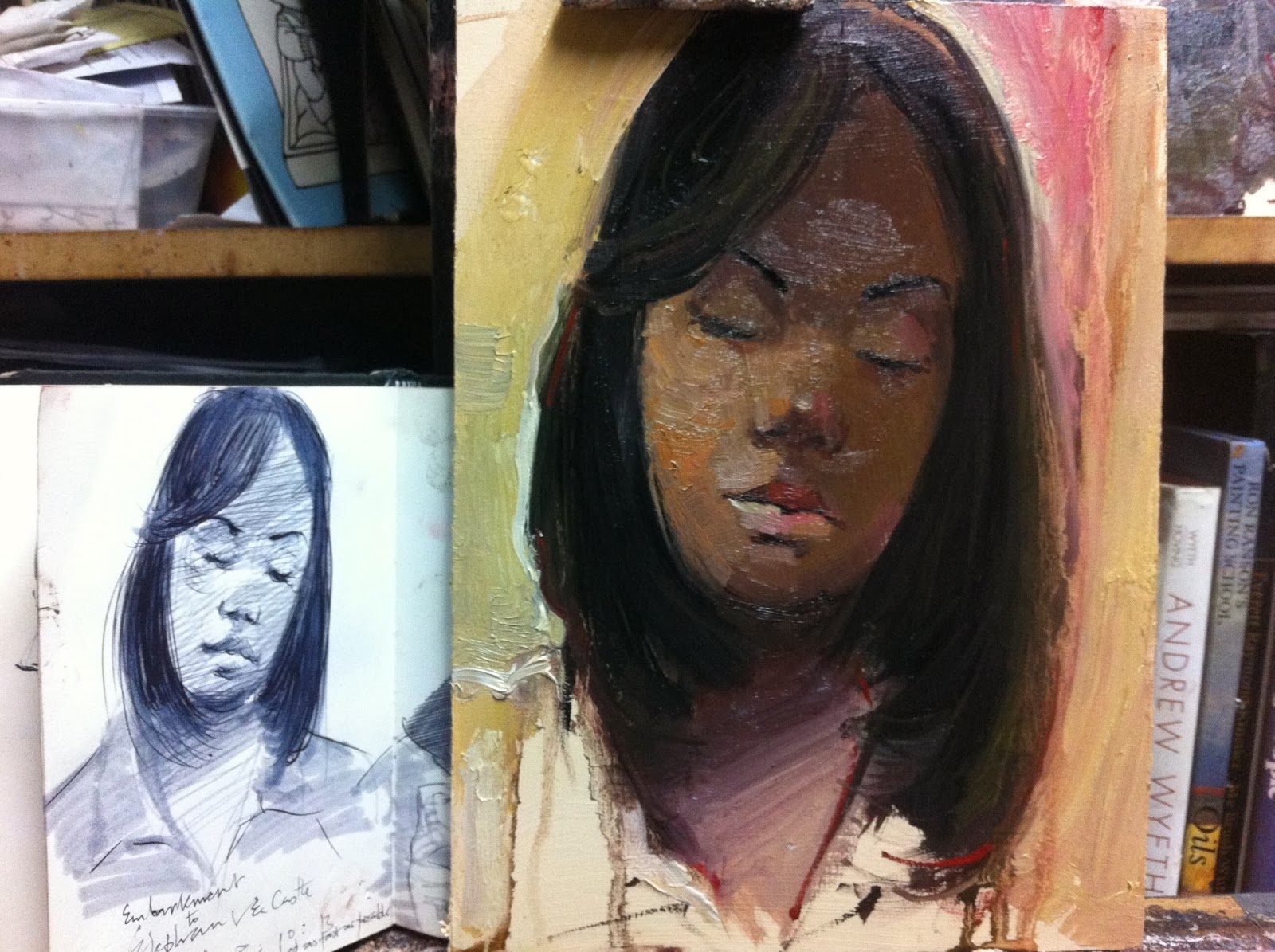
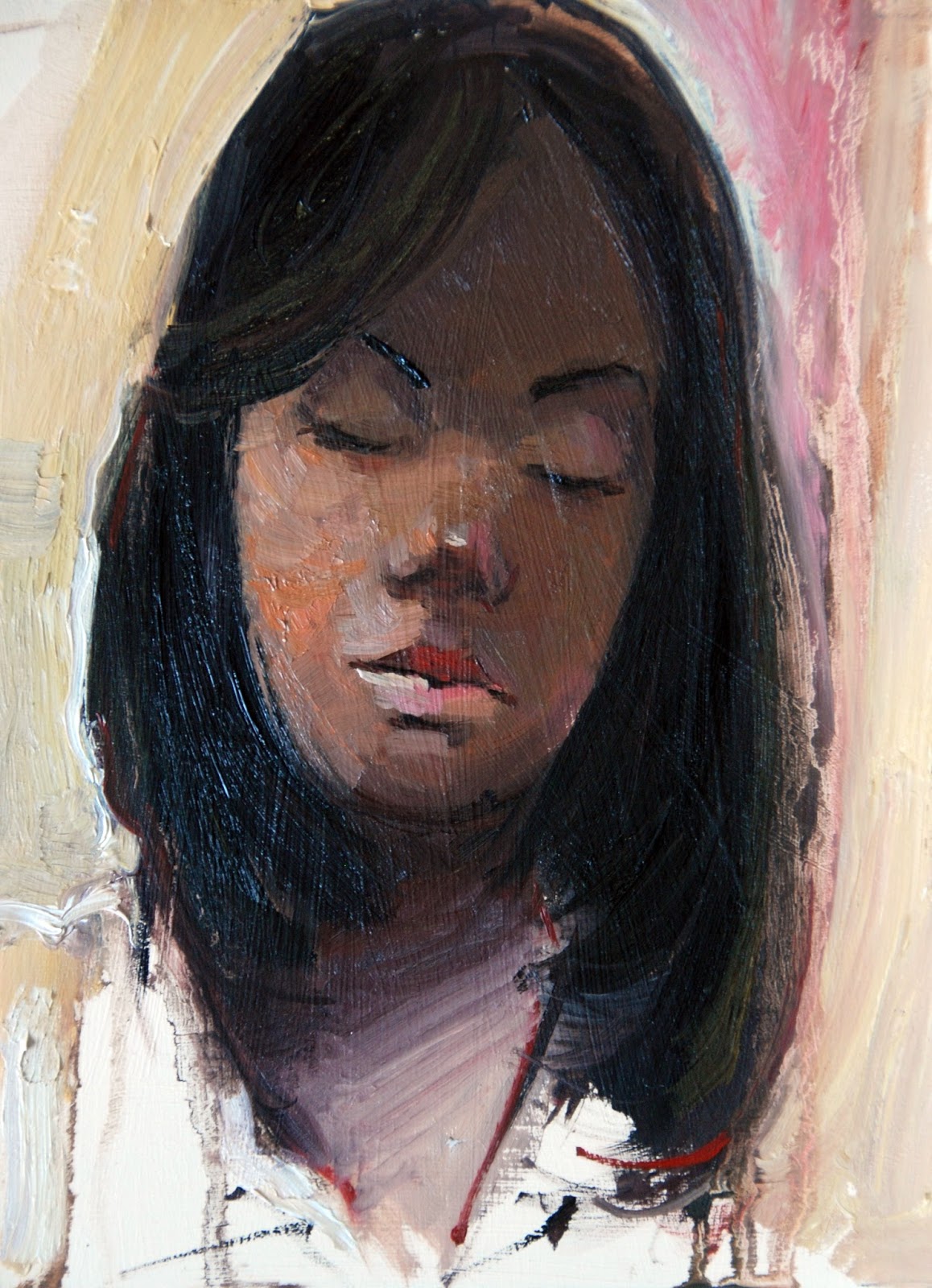
The BIG ISSUE SELLER Colour version 1


The Colour Version, 8" x 10", Oil on Board, 2012


The post that would be coming up here in the next few months would be how I convert my black and white sketches of Big Issue Sellers to Oil Colour sketches.

Stage 1


Here I sketch in oil the sketch on the board using a grid reference for accurate transfers. The program I use is called Accurasee you can download it for free and it is great for accurate grid scaling. I printed out the sketch to the proportion of the painting I was working on and did the initial sketch with a mixture of vermillion and black. Looking at my palettre you can see I have only 4 colours for this painting. Its a Zorn palette and I love it. I also did the same proportional grid lines on my board.


Stage 2


Here I do the initial broad block-in shapes to cover the whole face. working from larger dark shapes to smaller lighter shapes.


Stage 3


More detail is added, the goal is to draw into the broad shapes with more precise marks.


Final stage


Here, the refining takes place with a round pointed sable number 2. It's at this stage that the main features are refined and all the edges re-adjusted.


The sketch

Thursday, 8 September 2011

Scarlet Solitude, Oil on Board, 16" x 20", 2011


Today I was a able sketch a homeless guy I have always wanted to sketch.
Once he agreed I just got my studio to do a quick conversion to colour from the sketch without any reference to a colour reference.

I went about it thus

1. The board I used was given a colouful warm underpainting of light and dark tones.

2. I added liquin to the board to add some resistance, so the colours don't sink.

3. I used the Zorn Palette for this piece, which consists of white, yellow ochre, cadmium red and Ivory black. It's a limited palette but very tonal and powerful!

4. I sketched the head in with mixture of red and back.

5.After which I just painted shape by shape from memory and from the sketch to get a feel of how I saw him today.

6. His face came out a bit longer but I was still happy with the result.

Thursday, 17 February 2011

DAZED, 7" x 9.5", Oil on board, 2011


This is another transformation from black and white to colour.

1.I started with a Lightly toned gessoed board,, the colour of the tone was light cream, a mixture I derived from white, yellow ocher and raw umber in acrylic colours.

2. I start to sketch directly with a brush and oil colour slightly diluted, this is a quick colour sketch and I don't plan to spend more than 45 mins. So it's Straight sketching and colour filling as I go along.

3. I start by using a light colour of a mixture that consists of yellow ocher, cadmium red and white, I grey and cool this mixture with a bit of blue. I apply this mixture to all the light planes of the head-forehead Cheeks, jaw, chin....

4. Next I get my dark tone by adding burnt sienna and Ultramarine blue to the mixture above. I apply this to all the dark passages.

5. I then soften the edges between the dark and light passages. and this creates a more solid looking face.

6. I then accentuate the lights and add darker details like nostrils and eye lashes with the tip of a round long sable brush.

7. I then work on the hood by simply starting from the dark side and moving into the light.

8. Then I add the background with some warm and cool browns to create a hazy background to show he is dazed.

9. I just wanted to do this one quickly to capture the guys mood, one that truly caught my attention in a 453 bus last week. I think I finished it in 30 minutes.
I think these colour sketches are good to train one to quickly capture gestures in colour.

Tuesday, 6 July 2010

LOVE AT FIRST SIGHT II, 8" x 6", mixed media on gessoed card, 2010


This is another transformation of my sketches to colour. I worked from memory with some notes I added on my sketch.

Here I used this sketch as a springboard and went a bit wild with my imagination.

This is how I went about it.

1.I sketched the face on a lightly ochre/brown washed toned surface, with a mixture of Terra Rosa and ultramarine blue.

2. Working this way brings an immediate harmony to the piece as the browns and ochers quickly form a warm colour scheme.

3. Then I used very light washes of skin tones to throw the interplay of light and shade on her face.

4. After this I used a very small sable rigger to put the main features in with delicate touches.

5. Now, I added in the dark "hoody" she had on, and the light beige jacket she was wearing, after this it looked OK and I thought it was fine and finished. I had left the background as the initial wash of ochre/brown, but it didn't bring out her face, there was some sort of clash.

6. So I decided to darken the background, that helped a bit. Then I did a bit of
scratching back with my Biro to enhance some lines and her hair.

7. Then I introduced coloured pencil marks when the piece was touch dry. This helped to spice up the value balance and add a varied mark to the oil brush-strokes.

8. Finally I added more wild strokes with my coloured pencil to spice up the background, so it would have a spontaneous effect that goes along with the title I planned to give the piece.

Thursday, 8 April 2010

MISERY, 8" x 8", Mixed Media on Canvas Board, 2010


This is another transformation from black and white to colour, using no colour references but working from memory. What drew me to this man was his interesting features, even though his face looked a bit hardened, there was a bit of beauty in the midst of the storms. I sketched this guy on the 30th of March last month, so his features were still fresh in my mind.

I went about this piece, thus

1. Stain the canvas board with a mixture of burnt sienna and raw umber oil washes

2. When happy with the background staining. I sketch the face in, with my sable brush pointed to give delicate marks of precision.

3. I went on to finish the sketching with oil washes and some thicker paint in the lighter areas, keeping all my colours with a more tonal feel, something I planned to experiment upon.


4. When the oil dried up, I now tried something quite new, I worked back to get the drawing with a ball point pen(bic biro, as I normally call them)I did this also to create some textures and a "etchy feeling" to the surface.

5. After that, I used some brown coloured pencils to add some light and spontaneity to the face, just to create some mood as it was almost lacking a bit of spark.


6. Then it was time to quit before further ruins

Thursday, 4 February 2010

MACKY, 9" x 12", Mixed Media on Paper, 2010

This is another transformation from memory.

This time I actually requested to sketch this homeless guy for an agreed price for just 5 minutes.


The sketch looked very brief but I worked on the colour transformation a bit more.

Steps
1. I used a canson orange paper

2. Started sketching with watercolour with a flat sable for the basic parts of this portrait.

3. Start under-painting of the whole face and other features with burnt sienna washes of watercolour and olive green.

4. I introduce chalk pastel with broad strokes all over the face and clothes to block in the initial colours

5.I then move on to wax crayons to add expressive strokes and tie up the structure and harmony of colour all over the piece. I love these wax crayons as they are less messy and reveal more of my passion for linear strokes.

6. I then finish up with a soft black oil base pencil to add more detail and recover some of the drawing that gets lost during the expressive wax technique.

7. Call it quits........

Saturday, 5 December 2009

Contemplation, 6.5" x 6.5", Gouache, 2009


This is another transformation purely from memory. I sketched this guy, he must have had a hard day at work. He looked like a builder to me. I loved his face and was quite pleased to get this opportunity to sketch him.

1. Get my museum mountboard and give it an acrylic wash base of cadmium yellow and yellow ocher.

2. I start by placing the main large shapes with my flat sable, no initial drawing in this one.

3. After the main shapes are in place I begin to use a glazing technique to keep laying colours until I get both transparency and opacity in various places as I want.

4.The remaining touches are done to add detail to the main features.

5. I soften the edges around the background by spraying water over the area.

6. I have to stop before this piece gets overworked by the glazing technique.